Light rail

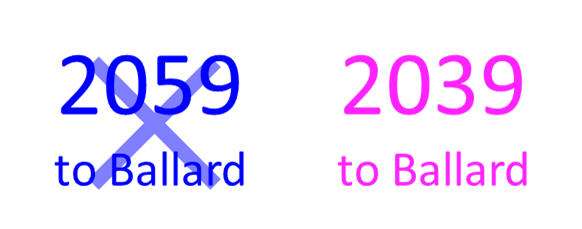
20 years sooner
for $15B less ↓

Our Solution
Trains to Ballard and West Seattle 20 years earlier
Trains every 90 seconds with greater capacity
$15B in savings
Automated Light Rail for Ballard and West Seattle
Sound Transit can reduce the cost of light rail to Ballard and West Seattle by at least $15B and save 20 years by adopting international best practices and building automated light rail from Ballard to West Seattle.
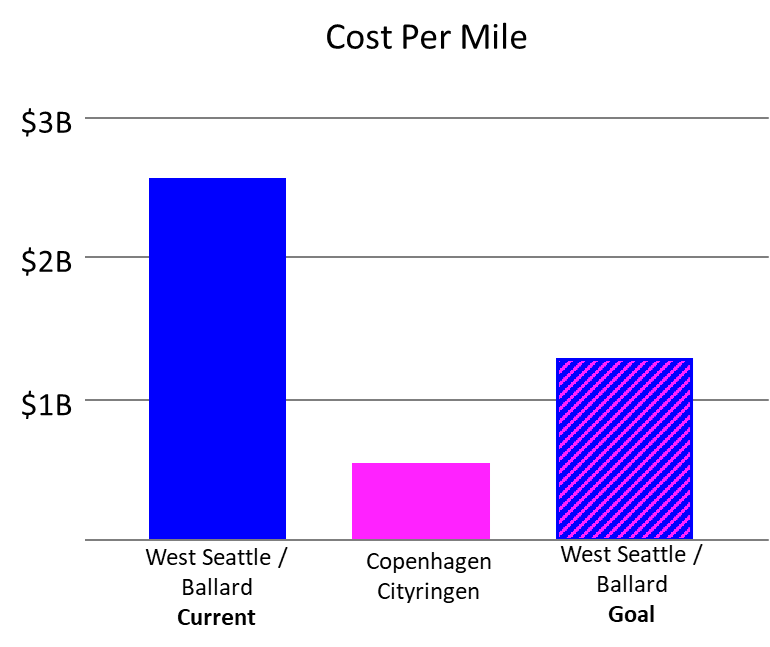
Reducing the cost of Ballard and West Seattle is essential. Sound Transit faces a $35B shortfall and is unable to deliver the full Sound Transit 3 plan within the 20-year time horizon of their current financial plan. Sound Transit's current cost estimate of $2.3B to $2.5B per mile for Ballard and West Seattle is surpassed globally only by much more complex projects in New York and Hong Kong.
Copenhagen — a peer city to Seattle — built its most recent rail extension in 2019 for one-quarter of the cost of Sound Transit's proposed West Seattle and Ballard project. The secret to Copenhagen's success is automation, which enables more frequent trains. Higher frequency dramatically reduces station size and its costs.
Setting the Baseline
Achieving these outcomes requires a return to first principles: Is there a better way to meet Ballard and West Seattle's transit needs? To be considered, any alternative must meet five criteria:
-
No delay in project delivery — this must not "reopen planning"
-
Better rider experience — more frequent and just as comfortable
-
Equal or greater capacity — at least 9,600 passengers per hour
-
Less disruptive — faster while impacting fewer blocks and intersections
-
Lower cost — a viable pathway to reducing capital cost by at least 50%
Three Steps
Step 1. Make the spine work
In 2012, Sound Transit produced an operating plan that showed how to split the regional spine without routing trains to Ballard and West Seattle. The infrastructure to operate this plan exists today. Using that infrastructure allows Ballard and West Seattle to operate as a standalone line in a dedicated second tunnel.
Step 2. Shorter, more frequent trains
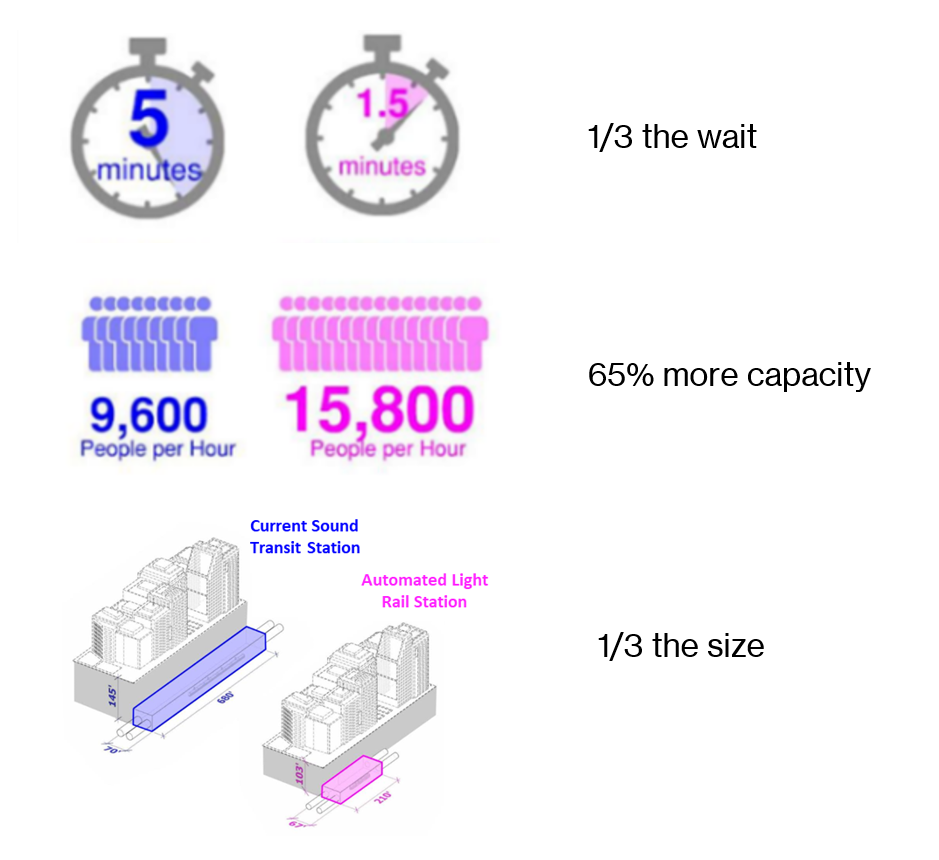
An automated light rail operating in a 2nd tunnel can exceed ST3's requirements through higher frequency and more efficient use of space. Automation allows trains to arrive every 90 seconds instead of every 5 minutes, increasing capacity from Ballard to West Seattle by 65% — from 9,600 to 15,800 passengers per hour.
Step 3. Shorter trains unlock much lower costs
Stations built to fit in a city — 210 feet long, not 680 — resulting in 70% less excavation. Smaller stations can fit within a single city block and avoid intersections, which reduces cost, construction time, and neighborhood disruption.
But what about...?
Making a change to autonomous trains raises political and technical questions. Concerns regarding redundancy, environmental review, maintenance facilities, and labor are manageable.
High-frequency automated service improves system resilience and increases overall downtown capacity from 51,200 to 63,600 passengers per hour.
Smaller stations reduce construction impact and limit the need for additional NEPA review.
Automated light rail doesn't eliminate current jobs or reduce future jobs — rather, it unlocks billions of dollars to put towards construction and system improvements, sending money to workers instead of bondholders.
Next Steps for Sound Transit
Sound Transit should issue a Request for Information to identify internationally proven approaches to delivering a fully grade-separated line within the planned station envelopes while meeting or exceeding the 9,600 riders-per-hour capacity target.
The RFI should examine technical design, NEPA, federal funding implications, regulatory changes, and integration with existing infrastructure, and be completed within six months.